
Somebody in the family always ends up doing the math before the trip even starts: how far is it from the hotel to the Acropolis, how many of those famous marble steps are actually involved, and whether the person with the bad knee or the recent hip surgery is going to spend the whole holiday sitting on a bench while everyone else disappears up the hill. It is a quiet worry, the kind that does not always get said out loud, but it shapes the whole itinerary before anyone has even landed.
Athens does not make this easy on paper. It is a city built on hills, paved in centuries-old stone, with sidewalks that narrow to almost nothing in the old neighborhoods and heat that can wear down even the fittest traveler by early afternoon. For someone with limited mobility, a bad back, a wheelchair, a cane, or simply a fear of long uphill walks in the sun, the idea of "seeing Athens properly" can feel like it is reserved for other people.
The good news is that this assumption is mostly outdated. Athens has changed a lot in the last decade, and there are now genuinely comfortable ways to experience the city's biggest sights without treating every outing like an endurance test.
What Actually Makes Athens Difficult to Navigate
The core issue is not distance, it is terrain. The historic center - Plaka, Monastiraki, the streets around the Ancient Agora - is full of uneven cobblestones, sudden inclines, and steps that were never designed with wheelchairs or walkers in mind. Even a relatively short walk from Syntagma Square to the Acropolis entrance can involve a steady climb that catches people off guard.
Heat compounds the problem. Athens summers regularly push past 35 degrees Celsius, and standing in direct sun waiting in a ticket line is a different experience entirely from a shaded museum hall. Anyone comparing the best time of year to visit Athens by weather will notice that spring and autumn are far kinder on the body, but even then, the hills do not disappear.
Why "Just Take It Slow" Isn't Always the Real Answer
Well-meaning advice often boils down to "pace yourself" or "take taxis between sights." Both are reasonable in theory, but they miss something practical: taxis get you to the edge of a neighborhood, not through it. The most rewarding parts of Athens - wandering through the Ancient Agora, catching the view from Filopappou Hill at sunset, weaving through the stalls of the Monastiraki flea market - happen on foot, or at least on some form of slow-moving transport that lets you stop, look, and linger.
This is where the usual advice runs out of road. A traveler with limited mobility does not just need to get from point A to point B. They need a way to actually move through the city at close range, stopping at a café, pausing by a ruin, without every ten minutes becoming a negotiation with pain or fatigue.
Rethinking Mobility: Vehicles That Do the Work for You
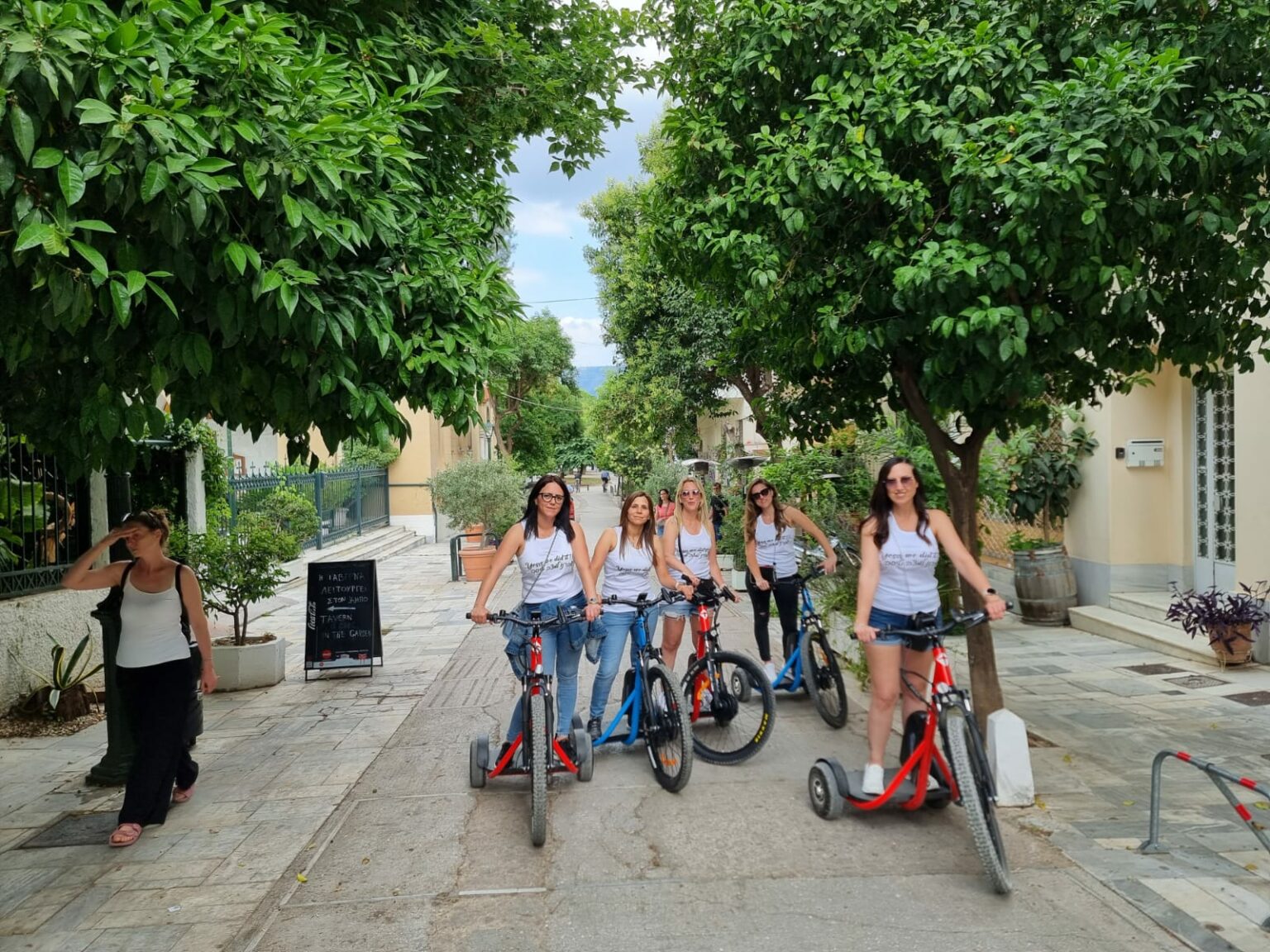
This is where electric transport has quietly changed what is possible. Three-wheeled electric trikes, for instance, remove two of the biggest obstacles at once: there is no balancing required, unlike a bicycle, and there is no pedaling effort, since the motor handles the hills. Someone who could never manage the climb toward the Acropolis viewpoint on foot can ride there comfortably, feeling the breeze rather than the burn.
This matters more than it might sound. A steep street in Koukaki or a long stretch near the Panathenaic Stadium stops being a dreaded obstacle and becomes just another part of the route. Guided e-trike tours built around this idea let people with joint pain, limited stamina, or mobility aids join a normal sightseeing tour instead of a scaled-down version of one.
Who This Actually Helps
It is easy to assume this kind of solution is only for older travelers, but the reality is broader. Someone recovering from surgery, a parent with a toddler who cannot walk five kilometers, a solo traveler managing chronic pain, or simply someone who would rather spend their energy enjoying Athens than surviving it - all of these people benefit from transport that removes physical strain from the equation.
Planning a Route That Respects Your Limits
A good accessible day in Athens usually blends a few elements: some guided movement through the city on wheels, short walking segments at the sights themselves, and enough shaded breaks to avoid overheating. The Ancient Agora, for example, involves more walking on uneven ground than the flatter, paved paths near the Temple of Olympian Zeus, so it helps to know this in advance rather than discover it mid-visit.
The National Garden is worth mentioning here too - it is one of the few genuinely flat, shaded, bench-lined spaces in central Athens, and a natural stop to rest between more demanding sights. Building a loose itinerary around a few of these calmer pockets, rather than trying to cram in every major landmark on foot, tends to produce a far more enjoyable day.
What About Cost and Convenience?
There is often a hesitation here, a sense that anything beyond a standard walking tour must be complicated to book or expensive to justify. In practice, guided e-trike tours in Athens run in a fairly ordinary price range for the city, generally between 40 and 79 euros depending on length and theme, similar to what a specialty walking or food tour might cost. Booking is usually no more involved than reserving a restaurant table, and a knowledgeable local guide handles the route planning, so nobody has to guess which streets are manageable.
The convenience factor tends to surprise people the most. Rather than researching accessible routes alone, a guide who does this daily already knows which side streets to avoid, where the shade is at 2pm, and how long a comfortable pace actually takes between Plaka and Syntagma.
A Note on Family Groups With Mixed Mobility
Mixed-ability groups are one of the trickiest travel puzzles: a grandparent with hip trouble, teenagers who want to move fast, and a five-year-old who tires out after twenty minutes. A tour built around e-trikes handles this reasonably well, since children as young as five to seven can ride along with a parent, while adults each manage their own vehicle at their own pace. Nobody gets left behind, and nobody has to slow down to accommodate someone else's stride.
Athens does not have to be a city that punishes tired legs or aching joints to be enjoyed properly. With a little planning, the right stretch of route, and transport that takes the physical strain out of the equation - companies like Ayo Tours Athens have built their guided e-trike tours around exactly this need - the Acropolis view, the backstreets of Anafiotika, and the buzz of Monastiraki are still very much within reach, however you happen to move through the world.
Frequently asked questions
What is an e-trike and why is it good for limited mobility?
An e-trike is a three-wheeled electric vehicle that combines stability with ease of use. There is no balancing required like on a bicycle, no pedaling effort since the motor powers the hills, and it moves slowly enough to see the city up close. This makes it ideal for anyone with joint pain, limited stamina, or mobility concerns who still wants to explore Athens properly.
Can I join a group tour if I use a wheelchair or mobility aid?
Yes. Ayo Tours guides lead groups that include people with various mobility needs. The e-trikes themselves are stable and require no physical exertion, and tours are designed with rest stops and shaded breaks. Contact Ayo Tours directly to discuss your specific needs and find the right tour option for you.
Which Athens sights are accessible on an e-trike tour?
Ayo Tours cover major landmarks including the Acropolis viewpoint, Ancient Agora, Temple of Olympian Zeus, Plaka, Monastiraki, Syntagma, and the Panathenaic Stadium. The e-trike handles the steep streets and uneven cobblestones that make these areas difficult to reach on foot, letting you experience each site without exhaustion.
How long are the tours and how much do they cost?
Ayo Tours offers 12 different themed tours ranging from €40 to €79, covering sightseeing, food, coffee, family, and photo experiences. Tour lengths vary by type and route. Check the Ayo Tours website or contact them directly for specific duration and schedule details.
What is the best time of year to visit Athens if you have mobility concerns?
Spring and autumn offer milder temperatures and are kinder on the body than summer, when heat regularly exceeds 35 degrees Celsius. However, the hills and uneven terrain remain year-round challenges. An e-trike tour removes much of this strain regardless of season, though cooler months are still more comfortable for any walking segments.